
Gold price forecast: XAU/USD holds steady above $4,100 as traders price in a December Fed rate cut. Weak U.S. data and shutdown optimism continue to support the bullish gold outlook.
Gold is maintaining a strong rally around $4,120–$4,130, driven by soaring expectations of Fed policy easing. Traders have rushed in on every dip, treating pullbacks as buying opportunities. This bullish tone has held even as U.S. stocks gain, reflecting confidence that any December rate cut could lift all markets.
Fed Rate Cut Bets Dominate the Outlook
The main driver is the growing belief that the U.S. Federal Reserve will cut rates in December. According to CME’s FedWatch tool, traders now put about a 67% probability on a 25-bp cut next month fxstreet.com up sharply from recent weeks. U.S. economic data have been soft. For example, the University of Michigan’s consumer sentiment index plunged to 50.3 in November (a multi-year low) fxstreet.com, signaling rising household anxiety. These concerns have fueled debate that the Fed may have tightened too far. JP Morgan analysts even forecast gold averaging above $5,000 by late 2026reuters.com, highlighting strong central-bank demand and an expected Fed easing cycle. Lower bond yields and a softer dollar backdrop are now giving consistent support to gold’s uptrend.
Shutdown Optimism & Market Dynamics
U.S. politics has also played a role. Over the weekend, the Senate approved a stopgap funding measure to end the government shutdown fxstreet.com. This gave the dollar a modest lift, but it has not derailed gold’s advance. In fact, gold has risen alongside stocks a rare risk-on behavior for a safe-haven asset underscoring how entrenched the Fed-cut narrative has become. Even as equities climb and the dollar firms, gold’s bullish momentum remains intact fxstreet.com thanks to the anticipated policy easing.
Meanwhile, U.S. Treasury yields are relatively contained. The 10-year yield sits near 4.11% fxstreet.com, and real yields have ticked only slightly higher. Normally a firming dollar and rising yields would pressure gold, but for now bullion holds steady. In fact, safe-haven demand continues quietly in the background: the World Gold Council reports that global gold ETFs drew net inflows of 54.9 tonnes in Octoberfxstreet.com evidence that investors are still hedging U.S. risks with gold.
Market Sentiment & Safe-Haven Flows
Overall sentiment remains supportive of gold. Equity markets are on a tear, yet many investors still add gold as a hedge. The combination of contained yields, a steady dollar, and continued ETF buying suggests gold’s appeal is very much alive. In short, weak U.S. data have reinforced gold’s safe-haven role rather than undermined it.
Technical Overview Gold’s Upside Target
Technically, gold looks poised for further gains. On hourly charts, XAU/USD has broken a downtrend line and reclaimed $4,000 as support, forming higher highs and higher lows. Momentum indicators agree: the 14-day RSI is climbing, reflecting strong buying pressure fxstreet.com.
- Immediate Resistance: ~$4,100. A clear daily close above $4,100 would confirm last week’s breakout.
- Next Targets: $4,160–$4,180 (recent swing high) and $4,220–$4,240 (prior consolidation top). Clearing these would open the path to the all-time high zone near $4,350–$4,375.
- Support Levels: $4,000–$4,010 (psychological pivot), $3,940–$3,950 (recent demand zone), and $3,880–$3,900 (base of October’s rally). A break below ~$3,950 would warn of a trend change; below ~$3,880 would invalidate the short-term uptrend.
In summary, the charts are bullish. As long as gold holds above $4,000, the uptrend is intact. The next clear hurdles lie around $4,100 and then $4,160 fxstreet.com. Only a sustained drop under $4,000 would shift the immediate bias to neutral.
What to Watch Next
Looking ahead, traders will focus on U.S. data and Fed signals. Wednesday’s ADP jobs report and Friday’s nonfarm payrolls could reinforce or dampen Fed-cut expectations. Further weakness would likely boost gold, while surprise strength might cap gains. Fed officials’ remarks will also be watched for any shifts in guidance.
On the price charts, bulls want to see a sustained move above $4,100 to extend the rally toward $4,200 $4,240. The bearish scenario would unfold if gold falls below $4,000 in that case the first support is $3,950 and then $3,900. A break below $3,900 would signal a deeper correction.
My Personal Thoughts
I remain bullish on gold’s outlook. Its ability to stay above $4,100 even as risk assets advance shows how convinced traders are of an upcoming Fed pivot. Every test of $4,000 has drawn buyers, making it a strong floor. Given the backdrop of weak economic data and strong central-bank demand, I expect any pullback to be shallow. My next upside target is around $4,200, and I would view dips as buying opportunities while keeping stops tight.
Gold Price Forecast: XAU/USD Holds $4,130 Bulls Eye $4,200 Breakout
Source: TradingView.com
Gold Price Forecast & Trade Setup XAU/USD
Quick Picture
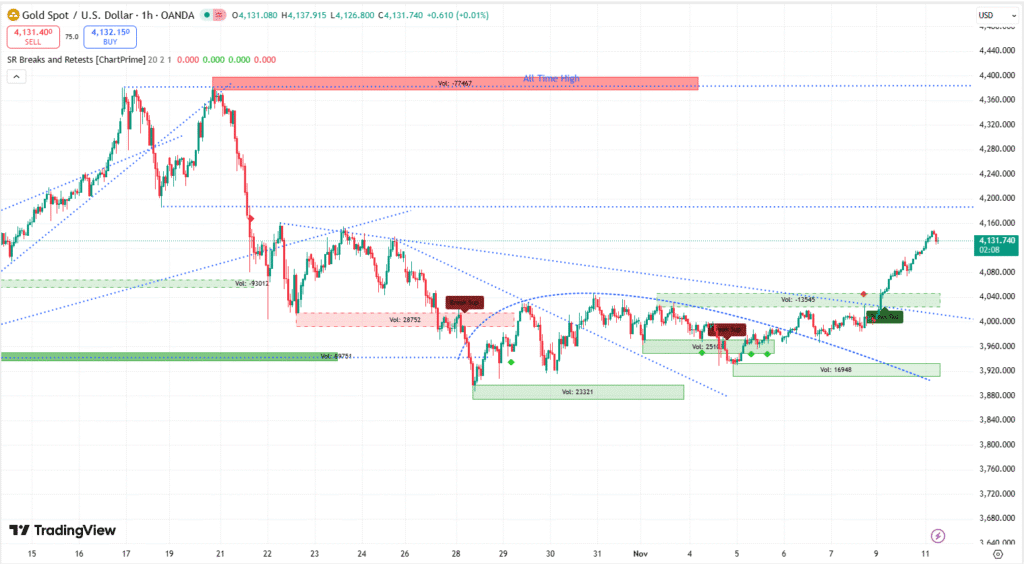
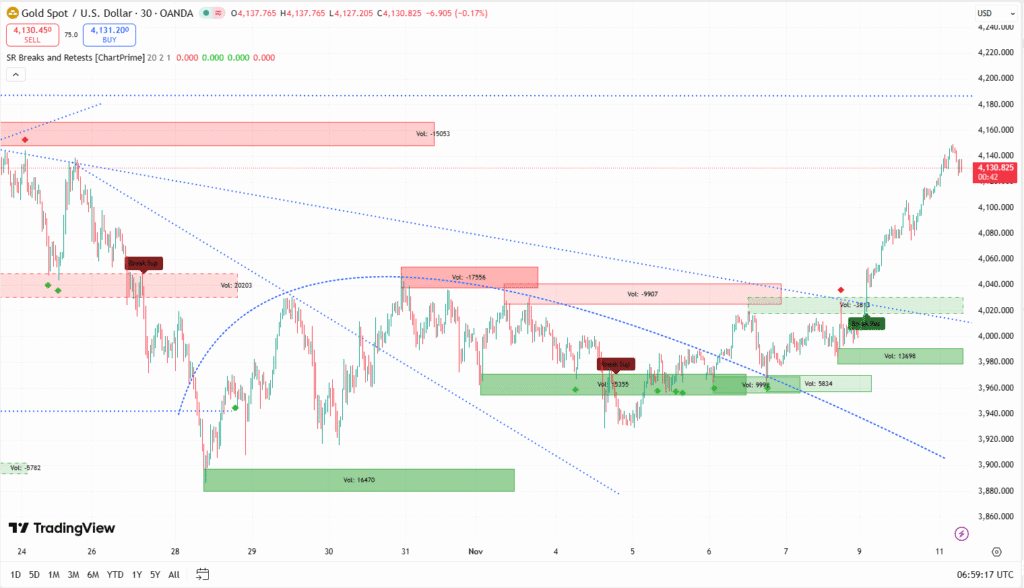
Gold is trading around $4,130 after a strong rebound from last week’s lows near $3,870 The downtrend from October has been broken: price found support around $3,980 and launched a sharp rally. This move pushed XAU/USD back above the key $4,000 level, flipping the short-term structure bullish. Buyers are now firmly in control, as evidenced by a series of higher lows/higher highs on the H1/M30 charts and sustained trading above moving averages. Underpinning this rally are dovish U.S. expectations markets are pricing roughly a 64% chance of a Fed rate cut next month which weakens the dollar and supports gold.
On higher timeframes, daily indicators also favor bulls. The 14-day RSI on the daily chart sits near 60 (above its midline), signaling room for further upside. Gold is testing a three-week high ($4,150) and eyeing the next resistance cluster. Key technical thresholds are in focus: for instance, FXStreet notes that a daily close above $4,129 (the 23.6% Fibonacci of August’s rally) would “unleash further upside,” targeting $4,200 and ultimately the all-time high at ~$4,382. In summary, the near-term structure is bullish. However, some indicators are overbought (e.g. H1 RSI >70 and waning volume near $4,140–$4,150) so a short pause or pullback into support zones is possible before the next leg higher.
Key Support & Resistance (Levels to Watch)
- Major Resistance: $4,350 – $4,382 (All-time high zone). A breach of this area (last record peak $4,382) would be needed for a fresh rally.
- Resistance 2: $4,220 – $4,240 (round number/previous swing top). A close above $4,200 noted as the next upside target – would open room to higher highs (toward ATH).
- Resistance 1: $4,160 – $4,180 (near-term weak high). This zone around the current swing top (H1/H4 supply) has capped recent upside. A clean break above $4,160–4,180 would signal continuation.
- Immediate Resistance: $4,100 – $4,130 (short-term pivot zone). Price recently cleared this breakout area; any retests here will be key. Daily analysis emphasizes acceptance above $4,129 for further gains.
- Pivot Area: $4,050 – $4,100 (psychological midline). The 21-day SMA sits around $4,086, marking initial support. This $4,050–$4,100 range (roughly the former breakout zone) now acts as a breakeven line.
- Support 1: $3,930 – $3,980 (demand zone). A high-volume buying area from last week’s dip. TradingView analysis identifies $3,980–3,930 as a key “demand zone” after the move. A drop into this range (near the prior $3,940–$3,960 level) would likely attract buyers.
- Support 2: $3,880 – $3,900 (secondary demand zone). The base of the correction price rallied strongly from this level around $3,880–3,900. A breakdown below that might risk the bullish thesis.
- Support 3: $3,820 – $3,840 (trendline / invalidation zone). Well below current price, a close under $3,840 would invalidate the short-term uptrend (e.g. a break below the lower channel/trendline).
Trade Ideas (Based on Price Behavior)
- Setup A – Momentum Long (Buy the Dips): Look to buy on a pullback toward the $4,100–$4,120 zone (recent breakout area). For example, one could enter near $4,115 after a confirmed M30/H1 bullish close above $4,120, with a tight stop around $4,080 (just below the minor swing low). This aligns with the trend continuation scenario; trading plans often target 4,160 and 4,220 as initial profit levels. Risk 1% per trade (RR 1:2.5).
- Why
The structure is bullish after clearing major resistance. Chart studies (e.g. TradingView analysis) show a clear buy-side bias: a Buy Setup entry around $4,040–$4,065 (the demand zone) with targets 4,120 and 4,160. Even though current price is higher, the same logic applies to a shallower retracement: RSI/momentum suggests healthy buying pressure remains, and $4,100 $4,120 has flipped to support. If gold holds above $4,000 and the recent breakout holds on the retest, the next targets ($4,160 then $4,220) become logical extensions.
- Why
- Setup B Fade / Short Near Resistance A short is riskier but can be considered if prices approach the upper resistance zone ($4,150–$4,220) and then fail. For instance, a bearish signal (like a strong rejection candle) near $4,150–$4,160 could be used to enter short, targeting roughly $4,090 and $4,040 on the way down. A stop-loss would go above the supply zone (e.g. above $4,180). The reward/risk here is ~2:1 if execution is precise.
- Why
The $4,150–$4,180 area has proven to be a supply zone (weak high at $4,150–4,160). TradingView analysis highlights that sellers dominate if gold fails there: a short setup from $4,150–4,160 has a high-probability down-leg toward $4,090 and $4,040. In our terms, this corresponds to roughly $4,150–4,220 as the resistance cluster. The idea is to capitalize on any exhaustion/profit-taking at resistance before bulls resume. This counter-trend trade should be small-sized, with stops just above the zone (e.g. $4,180) to cap risk.
- Why
Short-Term Forecast (Next 24–72 Hours)
- Bullish Scenario (Fed/US data dovish) If U.S. data and Fed expectations remain weak (boosting Fed cut odds), gold should extend its rally. In that case, expect a push toward $4,200–$4,240. Daily charts suggest $4,200 is the next round-number target, and if broken, the old high near $4,382 is in view. TradingView analysis similarly projects a fresh leg toward $4,220–$4,300 if a daily close clears $4,160. In short, bulls would keep control, and the market would look for new highs.
- Neutral / Consolidation: If risk appetite or Fed signals stay mixed, gold may oscillate between roughly $4,050 and $4,150. A sideways range roughly between the 21-day SMA ($4,086) and recent highs is likely. Intraday swings in this band would reflect shifting sentiment; ultimately, continued trading above $4,000 would keep the medium-term uptrend intact, suggesting any consolidation is likely just a pause before higher levels.
- Bearish Scenario (USD/Yields rebound) If the U.S. dollar strengthens or Fed-speak turns hawkish, gold could retrace more sharply. A break below the $4,050–$4,086 support zone (21-day SMA) would open a slide toward the $3,900–$3,950 area. Notably, FXStreet identifies $3,973 as a key 38.2% Fibonacci support of the rally; a sustained drop below this level would seriously undermine the current bullish outlook. In practice, a swift decline to $3,900 or lower would likely occur only on a major risk-off shock or clear hawkish signal. As always, we’d reassess the bias if gold fails below $3,900.
Summary: Gold’s short-term outlook is bullish, supported by strong technical momentum and dovish Fed bets. As long as the $4,000 zone holds, expect continuation toward $4,200+. Key upcoming U.S. releases (e.g. ADP jobs, ISM data) and any Fed commentary will set the next tone. A decisive close above the resistance cluster ($4,160) would affirm bulls, while a failure there could trigger a mild pullback into the demand zone. Trade carefully, use stops, and keep an eye on how price reacts at these technical levels.
What is the key resistance level to watch for XAU/USD this week?
The most important resistance zone this week is $4,130–$4,150. A confirmed daily close above this level could trigger a breakout toward $4,200 and possibly all-time highs around $4,382.
Is gold still a good buy above $4,130?
Yes, but only if price holds above $4,130 with strength. A clean breakout and retest of this level would offer a momentum long setup. If gold fails to hold $4,130, it’s better to wait for a dip into support zones like $4,086 or $4,050.
What could cause gold to drop below $4,000 again?
A stronger U.S. dollar, hawkish Fed comments, or unexpected inflation data could trigger a selloff. If gold breaks below $4,000, next support sits at $3,973 – the 38.2% Fib retracement.
How can I manage risk when trading gold?
Stick to a 1% risk rule. For example, if you have $10,000 in your trading account and your stop-loss is 30 pips, you should only trade ~3.3 oz (0.033 lots) to stay within the $100 risk limit.
Should I trade gold during news events like NFP or CPI?
Avoid entering trades during the first 5–15 minutes of high-impact news releases. Let the volatility settle first. Wait for confirmation candles and clean setups after the news spike.