
Gold price forecast: XAU/USD steadies near $4,100 as traders weigh Fed rate cut hopes and U.S. government reopening optimism.
Introduction
Gold prices are holding steady near $4,100 per ounce, cooling off slightly after a strong two-day rally that carried the yellow metal to a three-week high around $4,150. Traders are taking profits as optimism grows over the imminent U.S. government reopening and fresh bets on a Federal Reserve rate cut in December.
While the short-term tone has turned cautious, the underlying sentiment toward gold remains upbeat. The combination of soft U.S. labor data, a weaker dollar, and expectations of easier monetary policy continues to support the broader bullish case for gold.
In today’s gold price forecast, we break down the fundamental and technical drivers shaping the XAU/USD outlook and why this current pause could be a setup for the next move higher.
1.Fed Rate Cut Bets Keep Gold Supported
The primary narrative driving gold this week is the renewed speculation about a Federal Reserve rate cut before year-end. Traders are increasingly confident that the Fed will ease policy in December as signs of a slowing U.S. economy continue to build.
According to the Automatic Data Processing (ADP) report, U.S. private employers shed an average of 11,250 jobs per week in the four weeks ending October 25. This marks a clear deterioration in labor market strength, following months of modest gains earlier this year.
The weak jobs data quickly reignited dovish bets, with the CME FedWatch Tool showing a 68% probability of a 25-basis-point rate cut in December up from 62% a day earlier. A few analysts, like Fed Governor Stephen Miran, even floated the possibility of a 50-bps move, citing softening employment and cooling inflation.
Lower interest rates tend to reduce the opportunity cost of holding non-yielding assets like gold. That’s why every tick lower in Treasury yields or Fed expectations typically translates into renewed buying interest in the metal.
According to Bloomberg, Traders are now positioning for the first policy easing since mid-2024, with gold and silver leading the commodity space in anticipation of a softer Fed stance.
Source: Bloomberg Markets
as long as rate-cut expectations stay alive, gold remains underpinned, even during minor corrections.
2.U.S. Government Reopening Cools Safe-Haven Demand
The second major factor shaping gold’s tone this week is Washington’s progress toward ending the record-long government shutdown.
After 42 days of closure, the U.S. Senate passed a temporary funding bill late Tuesday, keeping most federal agencies open until January 30. The bill now heads to the House of Representatives, where bipartisan support suggests a quick approval.
While this is good news for markets and the economy, it also means a short-term drag on gold’s safe-haven appeal. Risk appetite tends to improve when political uncertainty fades, pushing investors toward equities and away from defensive assets.
That dynamic explains why gold retreated from the $4,150 peak on Wednesday’s Asian session traders rotated back into risk-linked assets as optimism grew around the deal’s final passage.
Still, this isn’t necessarily bearish for gold. Once the government fully reopens, the release of delayed economic data will give the market fresh evidence on whether the economy is indeed slowing enough to justify rate cuts. If that data confirms weakness, gold could regain momentum quickly.
3.Dollar and Yields Attempt a Rebound
After falling for five straight sessions, the U.S. dollar index (DXY) finally found support near 99.40, staging a modest rebound. The recovery in the dollar, along with stable Treasury yields, briefly capped gold’s rally.
The 10-year Treasury yield held around 4.12%, while the real yield (inflation-adjusted) stood near 1.83%, still supportive of the precious metal in relative terms.
The inverse relationship between gold and yields remains one of the strongest macro linkages in today’s market. Every decline in yields tends to push gold higher as traders seek safety and better returns relative to fixed-income assets.
But for now, this yield stability is contributing to gold’s sideways movement near $4,100. The market appears to be in wait-and-see mode, awaiting the next round of economic signals and Fed commentary.
4.Market Sentiment Risk-On But Fragile
Investor psychology has shifted slightly toward a risk-on mood this week, driven by hopes of a soft landing and political stability in Washington. U.S. equity futures have rebounded, and Asian markets are showing gains as well.
However, this optimism remains fragile. The global economy continues to face persistent headwinds from slowing growth in China to lingering inflation pressures in developed markets. That uncertainty continues to anchor demand for safe-haven metals, even as traders take short-term profits.
According to Saxo Bank analysts, Dollar resilience and improved risk sentiment are keeping gold in a tight range, but the underlying demand base remains extremely strong due to macro uncertainty.”
This dynamic optimism tempered by structural risk is why gold has refused to give up the $4,000 handle despite several attempts by sellers. Every dip toward support has so far been met with solid buying interest from both institutional and retail traders.
5.Technical Overview: Key Levels to Watch
From a technical standpoint, gold remains in a constructive consolidation pattern following its sharp rebound from the $3,885 low seen late October.
Here’s how the setup looks right now:
Support Levels
- $4,085 – 21-day Simple Moving Average (SMA)
- $4,050 – psychological level
- $3,973 – 38.2% Fibonacci retracement of the August rally
- $3,900 – 50-day SMA and structural swing low
Resistance Levels
- $4,150–$4,155 – immediate resistance zone and three-week high
- $4,200 – next major psychological barrier
- $4,275–$4,380 – breakout target area and late-October swing highs
Short-Term Bias: Cautiously Bullish
Chart Context:
Gold is consolidating in a tight 4-hour range between $4,095 and $4,150, forming higher lows and signaling potential accumulation. A breakout above $4,177 would confirm continuation toward the daily resistance near $4,350–$4,400.
Indicators also align with this setup:
- RSI: 59, pointing slightly lower but well above the neutral 50 zone.
- MACD: Still positive, but momentum cooling typical of short-term consolidation.
- Price action: Trading above both the 20- and 50-day EMAs, confirming trend integrity.
In short, the technical picture favors dip-buying as long as gold holds above $4,060–$4,090. Only a sustained close below $4,000 would signal that buyers are losing control.
6.What to Watch Next
The market is now looking ahead to several key catalysts that could define the next leg for XAU/USD:
A.Fed Speakers and Policy Tone
A packed schedule of Fed officials including John Williams, Christopher Waller, Raphael Bostic, and Susan Collins will speak throughout Wednesday and Thursday.
Any dovish tone or acknowledgment of economic weakness could trigger a renewed rally in gold.
B.Resumption of U.S. Economic Data
Once the government reopens, we’ll finally get the official labor and inflation reports for September and October. These numbers will be crucial in confirming whether the Fed has the justification it needs to begin cutting rates.
C.U.S. Dollar and Bond Market Reaction
If the dollar weakens again or yields decline, it would remove the last short-term obstacle for gold to break above the $4,150–$4,200 zone.
Possible Scenarios
Bullish Case:
A clean break above $4,161 (recent swing high) could open the path toward $4,275 and eventually $4,382 the record high from late October.
Bearish Case:
Failure to hold $4,085 could invite a retest of $4,050 and $4,000. Below $3,973, Momentum turns negative with risk of a slide toward $3,900.
Base Case:
Sideways consolidation between $4,060–$4,150 while markets digest incoming Fed and government data.
7.My Personal Thoughts
The market feels like it’s resting before the next leg up. Every time we’ve seen this kind of pause where gold holds firm above its short-term averages after a rally it’s generally been a healthy consolidation, not a reversal.
Yes, the rebound in the U.S. dollar and the risk-on sentiment have limited upside momentum, but the macro structure remains bullish. Rate-cut bets, slowing growth, and strong central bank demand are a powerful trio of tailwinds that won’t disappear overnight.
I think gold will likely grind within the $4,060–$4,150 range for a short while longer. But once traders get confirmation of a Fed pivot or another weak jobs or inflation report we could see a renewed breakout above $4,200.
For me, any dip toward $4,080–$4,100 remains a buying opportunity, provided risk is managed tightly under $4,000.
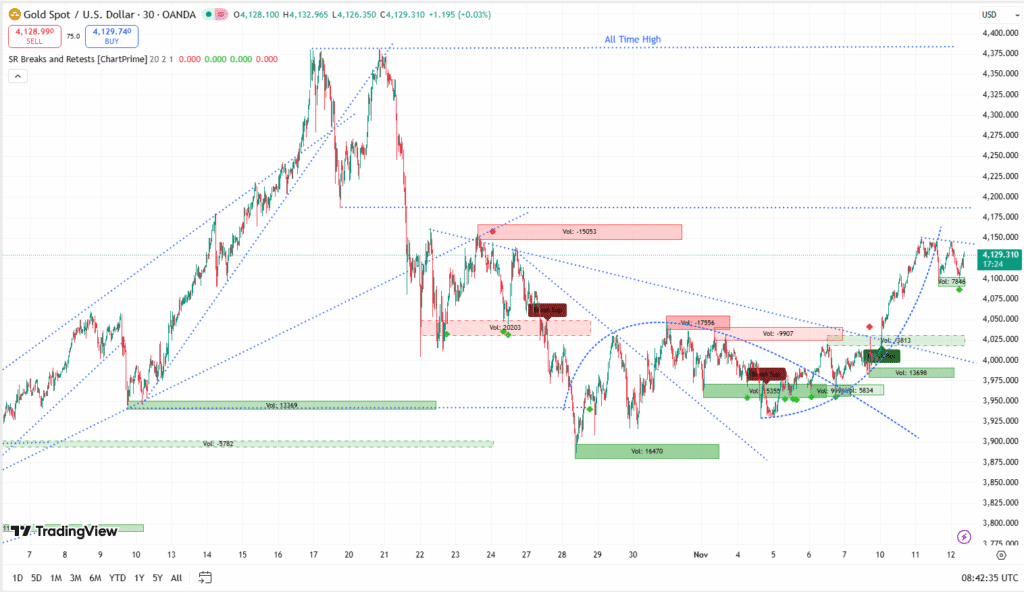
Source: TradingView.com
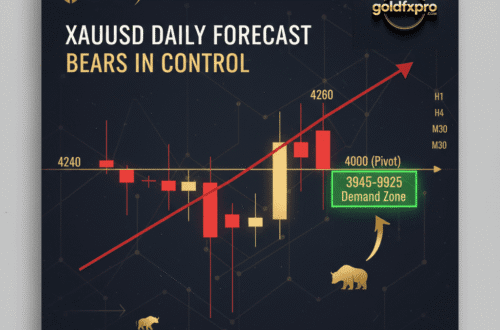
GoldFxPro Daily Forecast (XAUUSD) 12 November, 2025
Quick Picture (What I See)
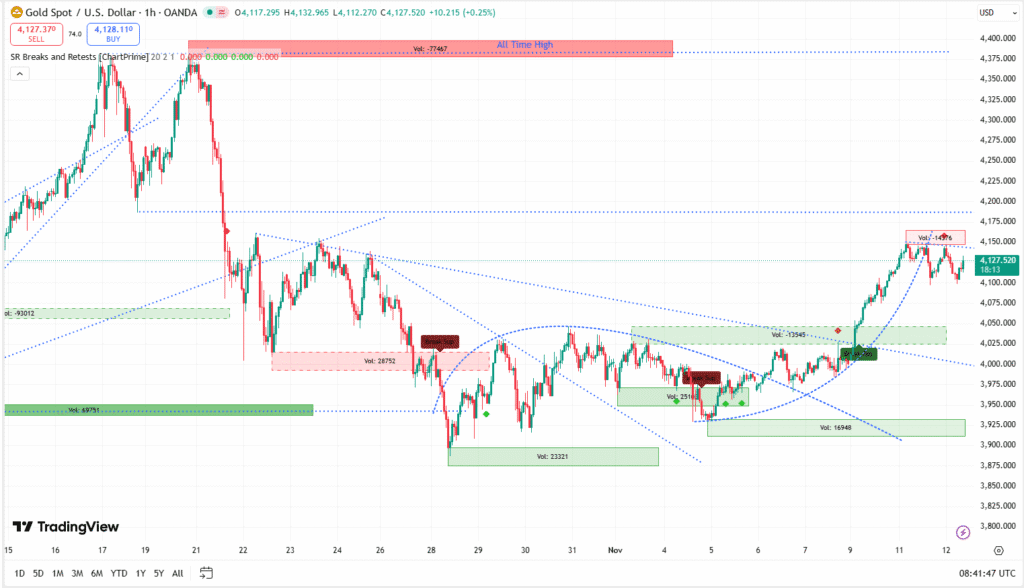
Gold (XAUUSD) is currently trading around $4,127–4,130, showing a mild intraday consolidation after a strong impulsive recovery from the $3,920 support area. The short-term market structure has shifted from bearish correction to bullish recovery, with clear evidence of a break of structure (BOS) on multiple timeframes M30, H1, and H4.
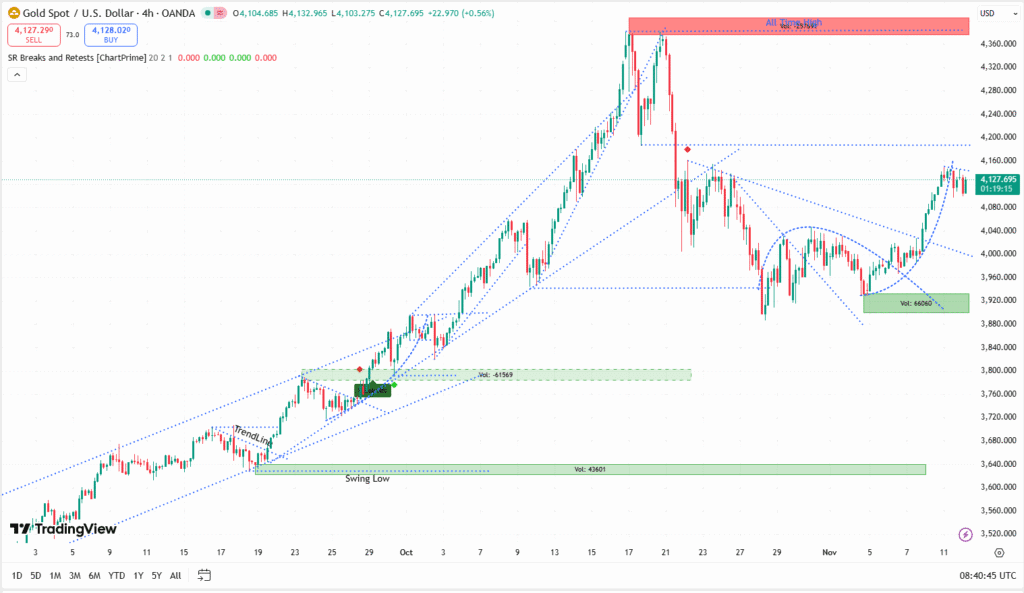
The recent breakout from the falling wedge (visible on H4) confirms a medium-term reversal from the $3,920 demand zone, where heavy buying volume entered. On lower timeframes (H1 and M30), gold has formed a rounded bottom pattern, retested the neckline around $4,075, and is now oscillating below minor resistance at $4,150.
The overall bias remains bullish above $4,075, but the momentum has cooled down temporarily after touching resistance near $4,150–4,175. The market looks like it’s in a minor pullback phase inside a broader bullish continuation structure, setting up for another potential leg toward $4,200–4,250 if buyers defend the $4,075 pivot zone.
Key Support & Resistance (Levels to Watch)
| Zone | Level | Description |
|---|---|---|
| Major Resistance | $4,250 – $4,300 | Key supply zone before the all-time high; previous exhaustion area. |
| Resistance 2 | $4,175 – $4,200 | Minor double top region on M30/H1; requires strong bullish volume to break. |
| Resistance 1 | $4,145 – $4,155 | Current intraday resistance, volume rejection seen on last 3 candles. |
| Pivot Area | $4,075 – $4,090 | Key structure level from neckline retest; acts as short-term control zone. |
| Support 1 | $4,020 – $4,040 | Short-term demand box; recent accumulation cluster on M30. |
| Support 2 | $3,965 – $3,980 | Prior base before breakout; clean FVG zone + strong reaction volume. |
| Support 3 | $3,920 – $3,940 | Major swing low; institutional demand (green box on H4) where reversal began. |
Trade Ideas
Setup A Momentum Long (Buy Continuation)
- Plan: Wait for clean bullish 1H close above $4,155 to confirm breakout continuation.
- Entry: $4,160 (after breakout retest).
- Stop Loss: $4,090 (below pivot area).
- Take Profit 1: $4,200
- Take Profit 2: $4,250
- Risk/Reward:1:2.5
- Why
Structure remains bullish above $4,075. The market has retested breakout structure successfully, showing bullish momentum from higher lows. Momentum breakout above $4,155 will confirm continuation toward next resistance zones. Volume profile supports this move as buy-side imbalance remains active from $3,975–$4,075.
Setup B Fade / Short at Resistance
- Plan: Sell rejection if price fails to close above $4,175 and forms bearish engulfing or pin bar.
- Entry: $4,170
- Stop Loss: $4,210
- Take Profit 1: $4,100
- Take Profit 2: $4,050
- Risk/Reward: 1:2
- Why:
The zone $4,175–$4,200 has acted as strong intraday rejection twice. Momentum loss and lower timeframe exhaustion could attract short-term sellers for 50–100 pips correction. This setup is only valid below $4,175 with declining volume and bearish confirmation candle.
Short-Term Forecast (Next 24–72 Hours)
If Fed or USD Outlook Turns Dovish:
Gold could extend its breakout above $4,175, targeting $4,250–$4,300 next. Softer USD or falling Treasury yields would amplify bullish sentiment. Momentum buyers likely re-enter on dips near $4,100.
If Market Stays Neutral/Cautious
Expect price to range between $4,075–$4,175. Sideways liquidity buildup is likely before a fresh move. Swing traders should wait for volume breakout confirmation either side.
If Fed or USD Outlook Turns Hawkish:
A rejection below $4,175 and sustained break below $4,075 could drag gold back toward $4,020 and possibly $3,965. In that case, market structure reverts short-term bearish with $3,920 as key defense.
Volatility Trigger:
Watch DXY 104.50–104.80. A breakout above that range could cap XAUUSD upside temporarily.
Summary:
Gold is pausing near resistance after a strong rally. The next 1H close above or below $4,155–$4,075 will decide whether this pullback is just a pause before $4,250 or a deeper correction back to $4,000.
Why did gold price pull back from $4,150 today
Gold retreated from the $4,150 level mainly due to profit-taking and a modest rebound in the U.S. dollar. Optimism over the U.S. government reopening also reduced short-term safe-haven demand, keeping prices near $4,100.
What is the key support level for XAU/USD right now
The immediate support for gold sits around $4,085, which aligns with the 21-day moving average. A deeper floor lies at $4,050, while the “line in the sand” for buyers remains near $3,973 — the 38.2% Fibonacci level of the recent rally.
What could trigger the next move higher in gold
A dovish tone from upcoming Federal Reserve speakers or weaker U.S. economic data could reignite buying momentum. A sustained break above $4,161 would confirm bullish continuation toward $4,275–$4,380 resistance zones.
How does the Fed rate cut expectation affect gold prices
Rate cut expectations lower bond yields and reduce the opportunity cost of holding non-yielding assets like gold. This typically boosts gold demand. Markets now price in a 68% chance of a 25-bps cut in December, supporting bullish sentiment.
Is gold still in a bullish trend despite today’s drop
Yes, gold remains in a broader uptrend as long as it stays above $4,000. The current pullback looks more like a short-term consolidation before another potential breakout attempt above the $4,150–$4,200 zone.
What events should traders watch next for direction
Key events include upcoming comments from Fed officials such as John Williams and Christopher Waller, the House vote on the funding bill, and the release of official labor and inflation data once the U.S. government fully reopens.