
Discover the real triggers behind the Bitcoin Crash 2025 and the $46,000 drop. See how this mechanical unwind impacts XAUUSD strategies for Gold traders today.
Bitcoin Crash 2025, Imagine waking up in early October 2025. Bitcoin has just smashed through a new all-time high of $126,272. The market cap is sitting at a massive $2.5 trillion. Everyone is euphoric.
Now, fast forward just 45 days.
By mid-November, the price has tumbled all the way down to the $80,000 range. Nearly $46,000 in value per coin vanished in weeks.
If you are a trader, you are probably asking the obvious question: Why?
Was there a ban on crypto? Did a major exchange collapse? surprisingly, the answer is no. There were no scary headlines or new regulations. Instead, what we witnessed was a brutal, mechanical chain reaction. It was a mix of too much debt, drying liquidity, and fear.
Here is exactly what happened and, more importantly, what this means for us as traders, especially if you are trading XAUUSD (Gold).
1. The Domino Effect of Leverage
Bitcoin Crash 2025 ,The trouble started on October 10. On that single day, roughly $19 billion in leveraged positions were wiped out. According to reports from the New York Post, this was one of the largest single-day liquidations in history.
When that much money evaporates, it breaks the market’s confidence.
After that initial crash, Bitcoin could not find its footing. The market became fragile. Every time the price dipped slightly, it triggered stop-loss orders and forced margin calls. As noted by analysts at EBC Financial Group, the sentiment flipped instantly from extreme greed to fear as liquidity drained out of the asset.
The Lesson: When a market is built on high leverage, you don’t need bad news to crash it. You just need a small push and a lack of buyers.
2. The Macro Shift: Risk-Off Mode
Bitcoin Crash 2025, Bitcoin does not exist in a bubble. It is part of the global financial ecosystem. During this period, the broader stock market was also showing signs of stress. Tech valuations were stretched, and hopes for interest rate cuts by the Federal Reserve began to fade.
According to Barron’s and [suspicious link removed], investors started pulling money out of “risky” bets. Since crypto is considered a high-risk asset, it was the first to get sold off.
While many people blamed “macro factors,” the real issue was how fragile the market structure was. The leverage amplified a standard market correction into a crash.
3. The ETF Exodus
Bitcoin Crash 2025, For a long time, ETFs were the heroes of the Bitcoin rally. But in this crash, they became part of the problem. Data showed massive outflows. One report highlighted that spot Bitcoin ETFs lost around $866.7 million in a single day (Barron’s). When ETFs sell that heavily, supply overwhelms demand. It creates a structural imbalance where the price has to go down to find new buyers.
Trader Tip: Don’t just look at who is buying. Ask yourself who is selling. Forced sellers, like ETFs facing redemptions or traders facing margin calls, will push prices down regardless of the fundamentals.
4. The Trap Door Effect
Bitcoin Crash 2025, Technically speaking, the chart looked ugly. Bitcoin broke through key psychological support levels at $100,000 and then $90,000. Yahoo Finance described this as a “trap door” effect. When liquidity is low and a major support level breaks, there is no one there to catch the falling knife. The drop accelerates because buyers are waiting for lower prices.
As traders, we see this in Gold/XAUUSD all the time. Once a key support fails, you need massive volume to reverse the trend. Without it, the price keeps drifting lower.
5. Why This Wasn’t About Fundamentals
Bitcoin Crash 2025, This is the most important takeaway. The Bitcoin network did not fail. No country banned it. The fundamentals were fine. This drop was purely mechanical. It was an unwind.
Analysts cited by [suspicious link removed] described it as a result of forced sellers and structural selling. For a trader, this distinction matters. If a crash is mechanical, a recovery won’t happen just because of a nice news article. It will only happen when the leverage is flushed out and the sellers are exhausted.
6. What This Means for Gold (XAUUSD) Traders
Bitcoin Crash 2025, You might be thinking, I trade Gold on GoldFXPro, why do I care about Bitcoin?
You should care because liquidity issues are contagious.
Usually, when risky assets like Bitcoin fall, safe havens like Gold rise. However, there is a dangerous scenario called a liquidity crunch. If the market panic is severe enough, traders sell everything including Gold just to raise cash. When you see a massive unwind in crypto, you need to watch your Gold positions closely.
- Best Case: Money leaves Crypto and flows into Gold (XAUUSD goes up).
- Worst Case: Global leverage contracts, and everything drops together (XAUUSD goes down).
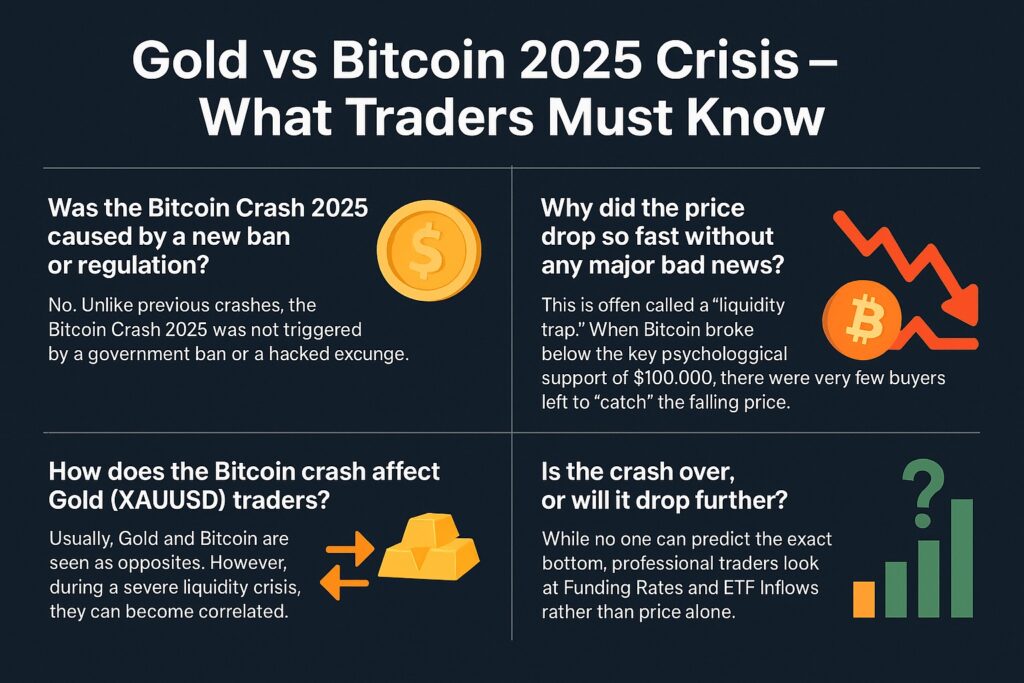
The Bitcoin Crisis 2025
The Bitcoin Crisis 2025 has reshaped market sentiment as extreme leverage, liquidity shortages, and forced liquidations triggered one of the sharpest declines in years. This infographic breaks down how the crash unfolded, why Bitcoin fell so fast, and what it means for Gold (XAUUSD) traders navigating today’s unstable markets. Understanding these mechanics helps traders prepare for volatility and manage risk during major crypto-driven market shocks.
Bottom Line
The drop from $126K to $80K wasn’t about Bitcoin being “bad.” It was about the market plumbing breaking under pressure. Going forward, keep an eye on Open Interest and Funding Rates. These are your early warning signals. And remember, whether you are trading Crypto or Gold, market structure often matters more than the headlines. Stay safe out there and manage your risk.
Disclaimer: This article is for informational purposes only and does not constitute financial advice. Trading financial assets like Bitcoin and Gold involves high risk. Always do your own research or consult a certified financial advisor before making investment decisions.
Was the Bitcoin Crash 2025 caused by a new ban or regulation?
No. Unlike previous crashes, the Bitcoin Crash 2025 was not triggered by a government ban or a hacked exchange. It was a mechanical collapse driven by extremely high leverage in the system. When $19 billion in leveraged loans were liquidated in a single day, it triggered a chain reaction of forced selling that pushed prices lower—regardless of positive adoption news or the absence of bad fundamentals.
Why did the price drop so fast without any major bad news?
This was a classic “liquidity trap.” Once Bitcoin broke below the key psychological level of $100,000, buyers disappeared. Thin liquidity meant automated stop-losses and liquidation engines pushed the price down violently. For traders, this proves that market structure and liquidity matter more than headlines. When no one is buying, even small selling triggers massive declines.
How does the Bitcoin crash affect Gold (XAUUSD) traders?
Gold and Bitcoin often move differently, but during a severe liquidity crisis they can become temporarily correlated. If large funds lose billions in crypto, they may be forced to sell profitable gold positions to raise cash quickly. For XAUUSD traders, sudden unexplained dips that mirror crypto sell-offs are a warning sign of a market-wide “cash crunch.”
What is a leverage unwind and why is it dangerous?
A leverage unwind happens when traders who borrowed money to buy Bitcoin are forced to sell as prices fall. Their selling pushes prices even lower, triggering more forced selling. This feedback loop turned a normal correction into a $46,000 collapse. Smart traders always monitor high open interest and overheated leverage as early danger signals.
Is the crash over, or will Bitcoin drop further?
No one can call the exact bottom. Professional traders focus on Funding Rates, Open Interest and Spot-ETF flows—not price alone. A real recovery only begins after forced selling is fully flushed out and leverage resets. Until ETF outflows stabilize and margin pressure eases, downside risk remains elevated, even if prices look “cheap.”