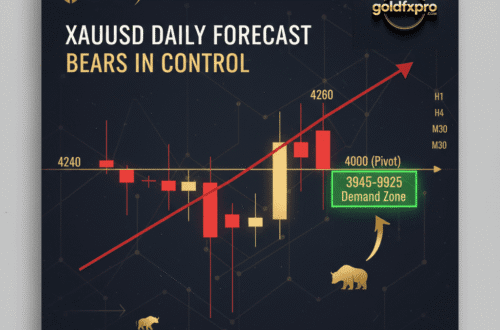

Gold price forecast: XAU/USD struggles below $4,050 as the firm US dollar and reduced Fed rate-cut expectations pressure sentiment. Traders watch $3,900 support ahead of key US data.
Hello everyone. If you’ve been watching the gold market lately, you know the atmosphere has changed. Gold, symbolized by the currency code XAU/USD, has been consistently giving up ground, sliding back toward that crucial $4,000 psychological barrier. It feels like the market has hit an air pocket, and the emotional tone has shifted from confident buying to a deep, palpable sense of caution.
In this detailed gold price forecast, we’re going to dive into the core reasons behind this shift. It’s a perfect storm of a strengthening US dollar, a sharp pullback in expectations for a Federal Reserve (Fed) rate cut, and a confused global risk appetite. We’ll look at the technical levels that truly matter right now and what you, as a trader, should anticipate next.
The Big Question Will Gold Hold the $4,000 Floor?
Right now, gold is trading around the $4,022 mark, hovering near its lowest point in about a week. The market feels heavy there’s a distinct lack of buying enthusiasm. With gold price forecast dominating searches and market discussions, the single most important question is will this $4,000 floor hold, or are we about to see a slide toward the next major support at $3,900?
The current tension is a direct result of macro forces that have forced traders to completely re-evaluate their positions. Let’s break down the main factors creating this downward pressure.
Fed Rate Cut Bets Collapse and Pressure Gold
The most significant event driving this recent decline is the dramatic adjustment in the Federal Reserve’s interest rate outlook. Just a short while ago, the market was almost certain the Fed would deliver a rate cut in December. That certainty has been completely shaken.
Multiple Fed officials have recently sounded a more cautious tone, suggesting they are in no rush to ease policy. A key statement came from Fed Vice Chair Philip Jefferson, who indicated the central bank must proceed slowly with any further cuts. This single comment was enough to send the probability of a December rate cut plummeting from nearly 60% down to around 42%, according to market data compiled by Reuters.
Why This Matters for Gold
Gold’s relationship with interest rates is paramount. When the market anticipates a rate cut, it means real yields (the return on bonds after accounting for inflation) are expected to fall. Since gold offers no yield, lower real yields make it a relatively more attractive investment, giving it a strong boost.
The reverse is true today. With rate cut bets dissolving, real yields are staying elevated, and gold, in turn, loses its shine very quickly. The past four days have been all about the market painfully adjusting to this new reality. The emotional shift from hopeful buying to defensive positioning is now complete.
This situation was made worse by the recent long US government shutdown, which delayed key economic data. Traders were essentially flying blind, which contributed to some earlier, hesitant buying. Now that data is returning and the Fed is being explicitly cautious, the adjustment is intense. As reported by Bloomberg, many major financial institutions are now warning that the Fed is unlikely to cut in December unless there’s a major, sudden deterioration in the economy. Gold is simply reacting to this real-time calculation.
US Dollar Strength Adds to the XAU/USD Headache
The second major headwind for gold is the resurgent US dollar.
When global risk sentiment weakens, as it is right now, the US dollar tends to act as the world’s ultimate protective asset. Investors move their capital out of volatile assets and into the safety of the dollar. We’ve seen the Dollar Index (DXY) rise for three consecutive days, holding firmly above the 99.30 technical pivot.
The Price Mechanism Problem
This is a fundamental problem for gold because it is universally priced in US dollars. A stronger dollar makes gold more expensive for holders of foreign currencies. This naturally suppresses demand and puts downward pressure on the price.
Crucially, this dollar strength isn’t coming from a place of economic growth optimism; it’s being fueled by pure risk aversion. As noted by FXStreet, many traders are buying dollars simply because they are uncomfortable and nervous ahead of delayed, high-impact US economic reports, most notably the crucial September jobs report scheduled for release on Thursday. The dollar is acting as a temporary shelter in the financial storm.
While US Treasury yields have eased slightly, with the 10-year yield pulling back to around 4.13%, the heavy emotional backdrop of dollar strength is overriding this. Normally, softer yields would support gold, but the current dollar dominance is simply too powerful.
Market Sentiment The Conflicting Safe-Haven Narrative
One of the most confusing aspects of the current market is the disconnect between general risk sentiment and gold’s performance.
Typically, when stock markets are falling and fear is high a classic risk-off environment gold rises because it’s seen as the primary safe-haven asset. But this week has been different. We are seeing negative risk sentiment, yet gold is failing to benefit. Why?
The answer lies, once again, with real yields.
Even with geopolitical tensions simmering and concerns over things like Nvidia’s earnings and AI valuations adding a layer of fear to the stock market, real yields remain elevated due to the recalibration of Fed expectations. These high real yields act as a hard cap on gold’s ability to rally. This is a clear case where the powerful macro fundamentals the interest rate environment are temporarily overpowering the traditional safe-haven narrative.
Emotionally, the market is completely confused. There is fear in the stock market, but zero enthusiasm for buying gold. Traders are hesitant, sitting on the sidelines, and waiting for the release of the nonfarm payrolls report to provide a definitive direction. This hesitation is only increasing the downward pressure on XAU/USD.
External Sources : reuters.com , fxstreet.com , bloomberg.com , cnbc.com
kitco.com , investing.com, marketwatch.com ,
Technical Overview Key Levels to Watch in This Gold Price Forecast
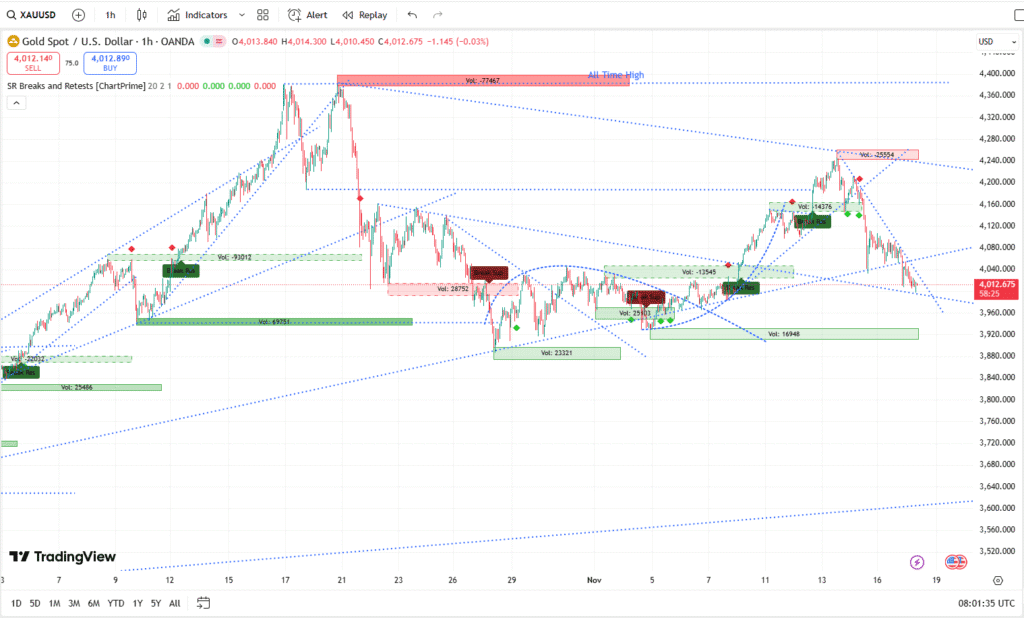
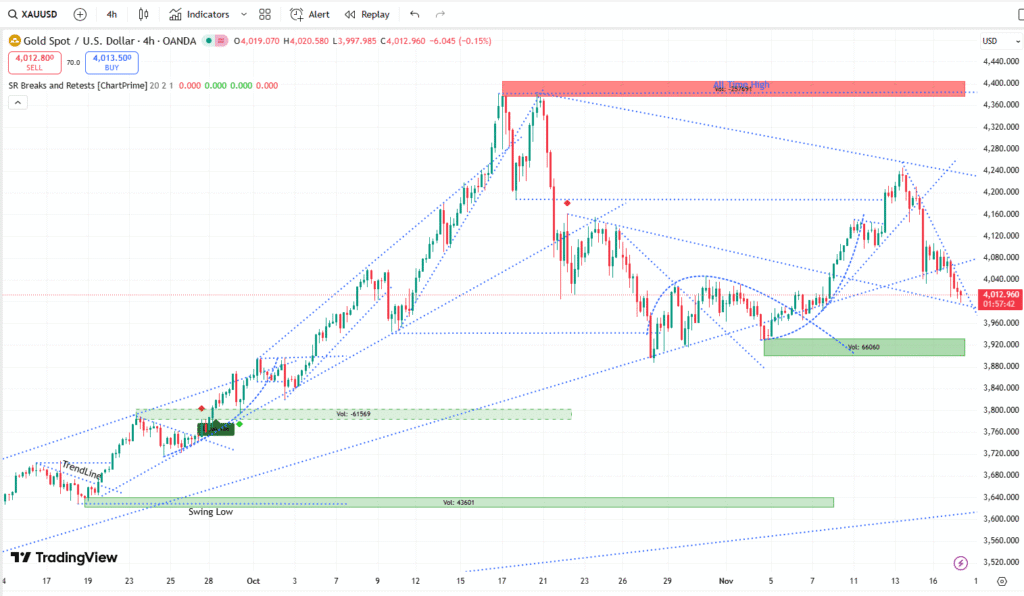
From a purely technical standpoint, the picture is becoming increasingly clear, leaning toward a bearish continuation. Momentum indicators, moving averages, and market structure are all suggesting a potential path to test the $3,900 zone.
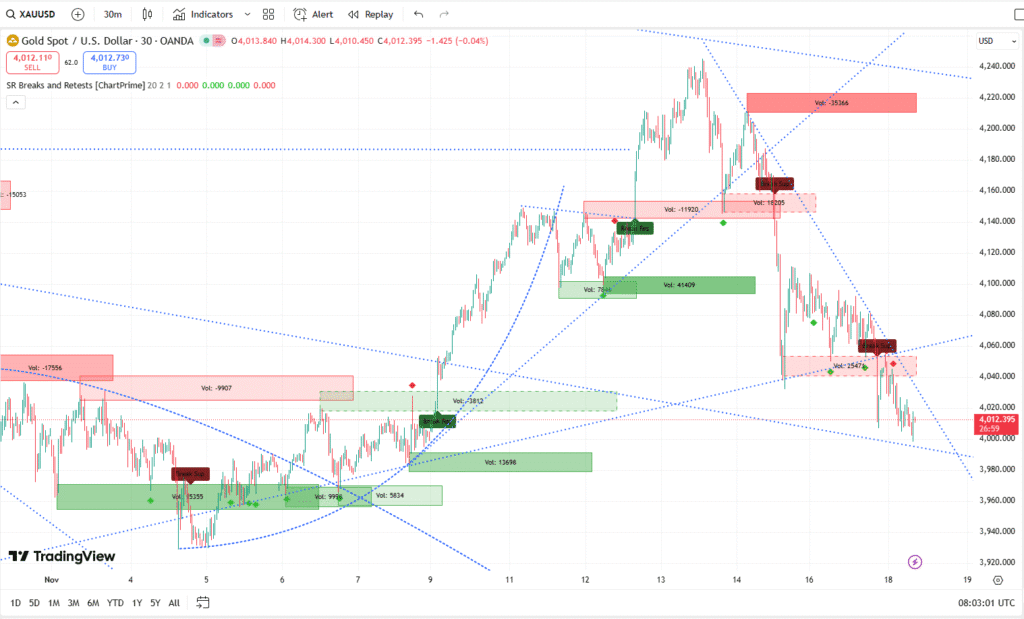
Support Levels The Critical Floors
- $4,000 – $3,990: This is the immediate psychological floor and short-term area of support. A break here would signal strong momentum from sellers.
- $3,960: A critical demand zone on the 4-hour (H4) chart, where institutional buyers might step in.
- $3,900: This is the major institutional Order Block (OB) and the absolute line in the sand. A clean break below this level would signal a major correction.
- $3,840: Secondary support if the $3,900 level fails to hold.
- $3,800 – $3,780: A deeper correction target and a significant liquidity pocket.
Resistance Levels: The Hurdles to a Recovery
- $4,048 – $4,060: This is the first major barrier, including the 21-day Simple Moving Average (SMA). Gold must close above here to relieve immediate pressure.
- $4,075: Corresponds to the 38.2% Fibonacci retracement level.
- $4,133: The important 50% Fibonacci retracement level. This level defines the mid-term momentum; a break above this would turn the short-term bias bullish.
- $4,160 – $4,180: A significant short-term top.
- $4,381: The standing all-time high.
Short-Term Bias: The bias is Neutral to Bearish as long as the price remains below the $4,060 level. A shift to a bullish outlook only occurs with a decisive, sustained move above $4,133.
Gold has been establishing a consistent pattern of lower highs across its daily and hourly charts. While the higher-timeframe uptrend isn’t technically broken, the medium-term momentum is severely weakened. The H1 chart shows a clear descending trendline that the price continues to respect. Unless gold can decisively break above this trendline, any rallies will remain shallow and short-lived.
What to Watch Next for XAU/USD
The market is currently in a state of compression, meaning it is gathering energy for a potentially large, directional move. The next 48–72 hours are absolutely critical.
The Bullish Case Bounce from $3,900
A meaningful recovery would require a confluence of factors:
- A strong rejection of the price from the $3,960–$3,900 demand zone.
- A clear Market Structure Shift (MSS) on the lower timeframes, showing buyers are finally back in control.
- A decisive break above $4,060.
- A daily close above $4,133, confirming the shift in momentum.
Potential Upside Targets (Source: Market Structure Analysis) $4,120, then the $4,160–$4,180 resistance zone. The larger targets of $4,220–$4,260 become viable only if macro data, specifically the jobs report, softens significantly and the US dollar begins a meaningful retreat.
The Bearish Case Breakdown Below $3,900
A bearish continuation will likely be fast and deep:
- A strong and confirmed break and close below $3,900.
- A failed retest of the $3,950–$3,980 zone, confirming the prior support is now new resistance.
- A rapid decline toward deeper liquidity pools.
Potential Downside Targets (Source: Liquidity Mapping) $3,880, $3,840, and the crucial $3,800–$3,780 level. This scenario becomes highly probable if real yields continue their upward march and the US dollar finds strong support heading into the major economic releases.
The Base Case Consolidation and Range-Bound Trading
The most likely scenario in the immediate future is consolidation between the $4,060 resistance and the $3,960 support. This choppy, range-bound environment is expected to persist until two key catalysts are released
- FOMC Minutes (Wednesday): Traders will scour these minutes for any deeper insight into the Fed’s new, cautious perspective.
- Nonfarm Payrolls (Thursday): This is the main event. A strong jobs report will fuel the dollar and push gold lower; a weak report will encourage a gold recovery.
My Personal Takeaway and Conclusion
The gold market right now just feels tired. Buyers have stepped back, and while sellers are in control, their actions aren’t aggressive enough to crash the market just yet. The price is hovering, waiting for instructions.
The $3,900 level is everything. If it holds firm, the medium-term bullish fundamentals (like global debt and central bank buying) will likely kick back in, and the market should turn higher again. However, if this level is broken decisively, the correction could be deep and incredibly fast.
For the moment, I am maintaining a cautious stance. There’s no compelling reason to initiate a long position until the chart provides clear, unambiguous evidence that buyers have returned and overpowered the current dollar-driven narrative. Stay patient, watch those key technical levels, and let the market show its hand after the economic data is released. Trade carefully.
Why is gold falling for the fourth straight day
Gold continues to decline because traders reduced expectations of a December Fed rate cut. The U.S. dollar has strengthened for three sessions, and hawkish comments from Fed officials have pushed real yields higher, which weighs directly on gold.
What is the most important support zone for XAU/USD now
The key support area sits between $4,000 and $3,900. The $3,960–$3,900 demand zone is especially important because it previously launched the rally toward all-time highs. A break below $3,900 could signal a deeper correction.
What could trigger a bullish reversal in gold
A softer U.S. dollar, weaker economic data, or dovish tones from Federal Reserve officials could support a bounce. A move back above $4,060 and then $4,133 would confirm the start of a bullish recovery.
How do Fed rate expectations impact gold prices
Gold rises when markets expect rate cuts because lower rates reduce the opportunity cost of holding non-yielding assets. When Fed officials push back against cuts, real yields rise and gold loses momentum. This is exactly what is happening now.
What happens if gold breaks below the $3,900 level
A daily close below $3,900 would shift the market toward a deeper correction. This could open targets at $3,880, $3,840, and the liquidity zone around $3,800. The broader uptrend would remain intact, but momentum would clearly turn bearish.
What should traders watch next for direction
Traders should monitor the U.S. Nonfarm Payrolls report on Thursday, delayed economic releases after the government shutdown, and upcoming speeches from major Fed officials. These will determine whether gold stabilizes or extends its decline.